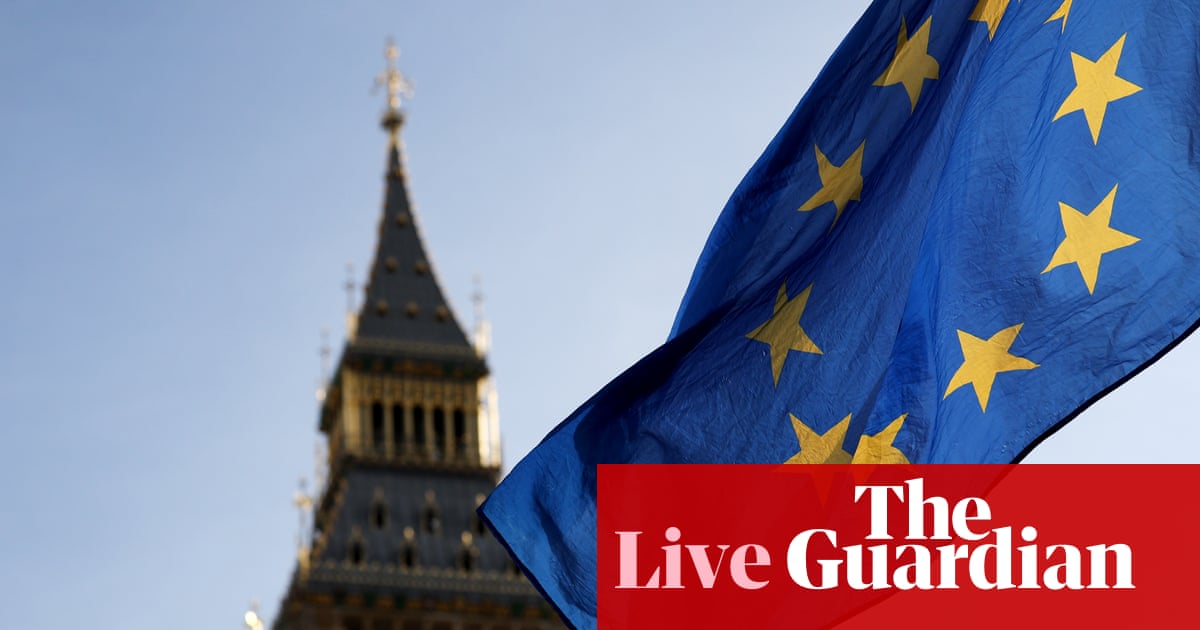
New research shows Brexit has cost UK up to £90bn per year in lost tax revenue, Lib Dems say
New research suggests Brexit has cost the government up to £90bn a year in lost tax revenue, the Liberal Democrats have claimed.
They have released the figures based on a new study by the National Bureau of Economic Research in the US that suggests the impact of Brexit on the UK economy has been worse than critics feared at the time.
The report has been written by five economists, including one from the Bank of England. They considered almost a decade’s worth of data and in their summary they say:
These estimates suggest that by 2025, Brexit had reduced UK GDP by 6% to 8%, with the impact accumulating gradually over time.
We estimate that investment was reduced by between 12% and 18%, employment by 3% to 4% and productivity by 3% to 4%.
These large negative impacts reflect a combination of elevated uncertainty, reduced demand, diverted management time, and increased misallocation of resources from a protracted Brexit process.
Comparing these with contemporary forecasts – providing a rare macro example to complement the burgeoning microliterature of social science predictions – shows that these forecasts were accurate over a 5-year horizon, but they underestimated the impact over a decade.
The Liberal Democrats asked the House of Commons library, which conducts authoritative research on behalf of MPs, to quantify what a reduction in GDP by 6% or 8% would mean for tax revenues.
The library said that if GDP were 6.4% higher in 2024/25 (the increase that would be need to compensate for the economy being 6% smaller than it otherwise would have been), tax revenues would have been £65bn higher.
And if GDP were 8.7% higher (the increase needed to compensate for the economy being 8% smaller), tax revenues would have been £90bn higher.
The library assumed the tax-to-GDP ratio remained at 34.7%.
Commenting on these figures, Ed Davey, the Lib Dem leader, said:
The most dishonest campaign in our history said it would save us £350m a week, but Brexit actually cost us £250m a day in 2025.
That is why we have the highest taxes ever, that is why we have sky-high bills, that is why we have a cost of living crisis.
Worst of all Labour know the cost of Brexit but refuse to do anything about it. My message ahead of the budget is clear: fix our broken relationship with Europe to end the cost of living crisis.
The Lib Dems want the UK to form a customs union with the EU. Next month they want to trigger a vote on this in the Commons.
Key events
Heidi Alexander chooses larger of two options for Heathrow 3rd runway, requiring part of M25 to be moved
Ministers have backed plans from Heathrow Airport’s owners that would see the M25 moved to make way for a third runway, PA Media reports. PA says:
Transport secretary Heidi Alexander rejected a rival proposal from Arora Group, saying Heathrow’s own plans were “the most credible and deliverable option”.
The Heathrow proposals involve building a 3,500-metre runway and require a new M25 tunnel and bridges to be built 130 metres west of the existing motorway.
The Arora plan, put forward by a group led by hotel tycoon Surinder Arora, was for a shorter, 2,800-metre runway that would not require diverting the M25.
In a written ministerial statement, Alexander said the proposal would still have “a considerable impact” on the motorway, and require the compulsory purchase of more homes around the airport.
A Heathrow spokesperson welcomed the decision, saying expanding the airport “will mean more connectivity, increased trade, improved passenger experience and a huge economic boost for the British businesses that will help design and build it”.
But the spokesperson added that “further clarity” was needed on how the next phase of the project would be regulated, calling for “definitive decisions” from government and the Civil Aviation Authority by mid-December.
The planned third runway is estimated to cost £33bn, including £1.5bn on moving the M25, and is expected to be fully privately financed.
It will see Heathrow’s capacity increase to 756,000 flights and 150 million passengers per year.
The government aims to make a decision on a planning application for Heathrow’s expansion by the next election, with the third runway becoming operational by 2035.
In her statement explaining why she has chosen the Heathrow Airport Limited (HAL) scheme, not the Arora Group/Heathrow West Limited (HWL) one, Alexander says:
Following a comparative assessment of the remaining proposals for Heathrow expansion, the government’s view is that the Northwest runway scheme brought forward by Heathrow Airport Limited offers the most credible and deliverable option, principally due to the relative maturity of its proposal, the comparative level of confidence in the feasibility and resilience of its surface access plans, and the stronger comfort it provides in relation to the efficient, resilient and sustainable operations of the airport over the long-term.
The HAL scheme is considered comparatively more mature in its approach to road infrastructure. While the HAL scheme requires major works to the M25, assessment indicates that the HWL scheme would also have a considerable impact on the M25.
We know we must provide as much clarity and certainty for communities affected by expansion at Heathrow, as soon as possible. While HAL’s scheme requires more land, it would require the acquisition of fewer residential properties around the airport than HWL’s scheme.
The runway length proposed by HAL – up to 3.5km – is considered to be advantageous in terms of providing greater resilience and potential futureproofing for next-generation aircraft when compared with the 2.8km runway proposed by HWL.
In the Commons Wes Streeting, the health secretary, has just started taking health questions. In response to a question from Labour’s Laura Kyrke-Smith, he has just confirmed that the budget will including funding for “a new generation of neighbourhood health centres to deal with the crumbling NHS we inherited”. (See 10.12am.)
There are two statements in the Commons today.
12.30pm: Keir Starmer on the G20
After 1.30pm: Ed Miliband, the energy secretary, on Cop30.
New research shows Brexit has cost UK up to £90bn per year in lost tax revenue, Lib Dems say
New research suggests Brexit has cost the government up to £90bn a year in lost tax revenue, the Liberal Democrats have claimed.
They have released the figures based on a new study by the National Bureau of Economic Research in the US that suggests the impact of Brexit on the UK economy has been worse than critics feared at the time.
The report has been written by five economists, including one from the Bank of England. They considered almost a decade’s worth of data and in their summary they say:
These estimates suggest that by 2025, Brexit had reduced UK GDP by 6% to 8%, with the impact accumulating gradually over time.
We estimate that investment was reduced by between 12% and 18%, employment by 3% to 4% and productivity by 3% to 4%.
These large negative impacts reflect a combination of elevated uncertainty, reduced demand, diverted management time, and increased misallocation of resources from a protracted Brexit process.
Comparing these with contemporary forecasts – providing a rare macro example to complement the burgeoning microliterature of social science predictions – shows that these forecasts were accurate over a 5-year horizon, but they underestimated the impact over a decade.
The Liberal Democrats asked the House of Commons library, which conducts authoritative research on behalf of MPs, to quantify what a reduction in GDP by 6% or 8% would mean for tax revenues.
The library said that if GDP were 6.4% higher in 2024/25 (the increase that would be need to compensate for the economy being 6% smaller than it otherwise would have been), tax revenues would have been £65bn higher.
And if GDP were 8.7% higher (the increase needed to compensate for the economy being 8% smaller), tax revenues would have been £90bn higher.
The library assumed the tax-to-GDP ratio remained at 34.7%.
Commenting on these figures, Ed Davey, the Lib Dem leader, said:
The most dishonest campaign in our history said it would save us £350m a week, but Brexit actually cost us £250m a day in 2025.
That is why we have the highest taxes ever, that is why we have sky-high bills, that is why we have a cost of living crisis.
Worst of all Labour know the cost of Brexit but refuse to do anything about it. My message ahead of the budget is clear: fix our broken relationship with Europe to end the cost of living crisis.
The Lib Dems want the UK to form a customs union with the EU. Next month they want to trigger a vote on this in the Commons.
Green party renews call for wealth taxes
Zack Polanski, the Green leader, has staged a photocall at Westminter to highlight his party’s call for wealth taxes in the budget. The Greens have published plans for what they call “fair wealth taxation measures”, which they claim could raise over £30bn a year.
Their proposals include a 1% tax on wealth over £10m, and a 2% tax from more than £1bn, raising £14.8bn; aligning capital gains tax with income tax, raising £12bn; and introducing national insurance on investment income, raising £6.1bn a year.
The Greens would spend the money on measures to alleviate the cost of living, including cutting energy bills, bringing energy and water companies into public ownership, getting rid of the two-child benefit cap and extending free school meals to all primary and secondary school pupils.
For a critique of these plans from the left, Aditya Chakrabortty’s Guardian column last week is worth reading.
DHSC says budget will help fund new neighbourhood health centres for England
At health questions today Wes Streeting is also likely to confirm a £300m capital investment for neighbourhood health centres in England. In a news release, the Department of Health and Social Care says the money – to be confirmed in tomorrow’s budget – will help establish a neighbourhood health service. It says:
The chancellor will double down on the government’s commitment of continuing to slash NHS waiting times in this week’s budget – today confirming the investment for hundreds of new neighbourhood health centres that will deliver healthcare direct to people’s doorsteps across the country …
250 new health ‘one stop shops’ will bring the right local combination from GPs, nurses, dentists and pharmacists together under one roof to best meet the needs of the community, starting in the most deprived areas.
The centres will be part of a new neighbourhood health service that will provide end-to-end care and tailored support – improving access to GPs, helping to prevent complications and avoid the frustration of being passed around the system.
The Financial Times says some of the new neighbourhood health centres will be funded with private capital. In their story, Chris Smyth, Laura Hughes and Gill Plimmer say the comparisons with PFI are likely to alarm some MPs.
NHS bosses have long pushed to be allowed to make greater use of external capital, including to rebuild hospitals and other large-scale projects.
But the Treasury has until now resisted. The change of heart will face fierce opposition from Labour MPs who have argued that reintroducing PFI, or a version of it, risks undermining confidence in the party’s NHS reforms.
The initial deals, which will count against the government balance sheet, are described by government sources as a “toe in the water” of private finance and justifiable on grounds of efficiency and speed.
Streeting expected to confirm sugar tax being extended to cover milkshakes and other milk drinks
Wes Streeting, the health secretary, is expected to tell the Commons later today that pre-packaged milkshakes and lattes will be covered by the sugar tax.
Currently milk-based drinks are exempt from the sugar tax, but this is due to end in the budget. Streeting is taking questions in the Commons later and, according to a report in the Times, he is expected to confirm the sugar tax extension.
Rachel Reeves, the chancellor, originally told MPs she was considering this option in her budget last year.
Explaining the origins of the sugar tax, PA Media says:
The sugar tax, also known as the soft drinks industry levy (SDIL), is a tax on pre-packaged drinks such as those sold in cans and cartons in supermarkets.
It applies to manufacturers and was introduced by the Conservative government in 2018 to help drive down obesity, including among children.
The government has also been looking at reducing the maximum amount of sugar allowed in drinks from five grams to four grams per 100ml, after which point they will be hit by the levy.
According to the Treasury, children’s sugar intake in the UK is more than double the recommended maximum of no more than 5% energy from free sugar.
The existing levy has led to a 46% average reduction in sugar between 2015 and 2020 for those soft drinks that were to be brought under the rules.
James Cleverly declines to full endorse Tory chair’s Nazi jibe about Reform UK
It is not just Labour attacking Reform UK. On Sunday Kevin Hollinrake, the Conservative party chair, posted a message on social media comparing a Reform UK badge to a Nazi swastika. In response to complaints, he took that post down, but replaced it with another (still up this morning) including a link to a Wikipedia page about a Nazi badge, implying the comparison has some merit. That did not quell the criticism, and yesterday Kemi Badenoch, the Tory leader, defended Hollinrake by saying he was just being funny.
But this morning James Cleverly, the shadow housing secretary, declined to fully defend Hollinrake. He said the Tory chair was “trying to make a point” but it was “not necessarily the way I would have made it”.
Cleverly told GB News:
The point that I think he is making is that – I mean, the situation with Nathan Gill, the former Reform leader in Wales who’s now been imprisoned for corruption charges having been bribed by Russia to promote pro-Moscow propaganda – is something that is worth highlighting.
Kevin sought to do that in his own way. That’s a decision that he made, but I think it is right, not that we criticise people who vote Reform – these are people who we need to win over, and indeed often win back to voting Conservative – but I think it is absolutely legitimate to ask some very, very serious questions about the motivation of some of the elected people within Reform.
Labour condemns Nigel Farage after he ducks calls for probe into potential Reform UK links to Russia
Good morning. Yesterday Nigel Farage, the Reform UK leader, finally addressed the report published by the Guardian a week ago that quoted multiple people recalling him making racist or antisemitic comments when he was a pupil at Dulwich College in south London in the late 1970s and 1980s. Before publication, a Reform UK spokesperson told the Guardian the claims were “entirely without foundation”. But Farage adopted a slightly different line when he was questioned by Gareth Lewis, BBC Wales’s political editor, who was conducting a pooled interview (ie, one for use by all media outlets). Farage was still quite dismissive but, when pressed as to whether he ever racially abused other pupils at school, he replied: “Not with intent.”
There is a clip of the interview here, but this morning the Today programme played a fuller version (available here, from 7.16am) which is worth hearing. The questioning by Lewis was excellent.
Here is our story, by Daniel Boffey, Henry Dyer and Mark Blacklock.
And here is a timeline showing how Farage’s response to these allegations has changed over time.
But racism was not the only difficult topic Farage had to face questions about yesterday. On Friday Nathan Gill, the former Reform UK leader in Wales, was sentenced to 10 and a half years in jail for taking bribes, when he was an MEP, to make speeches favourable to Russia, and Farage was also asked what he was doing to establish if other Brexit party MEPs had been offered bribes in the same way. (Gill was a Brexit party MEP when he took the bribes, but the Brexit party later turned into Reform UK.) Farage insists Gill was a one-off “bad apple”. Asked why he was not carrying out an investigation to see if anyone else in the party was not targeted in the same way, Farage replied:
I haven’t got a police force, I haven’t got access… I can’t access your phone message, I can’t access your emails … Unless I can do that, I can’t investigate. You’ve got to have somebody with investigatory powers.
Asked if he had asked people in his party about this, he replied:
Well, I’ve asked everybody: have you ever taken money you shouldn’t have taken from anybody … and no one said yes.
Asked if that was good enough, Farage deflected the question, and asked what Labour and the Tories were doing about people in their parties.
Labour says this is not good enough. In a statement issued in response to the Farage interview, Anna Turley, the Labour chair, said:
Nigel Farage assured the public his former right-hand man was decent and honest before he was found to have taken pro-Russian bribes. Now he says he’s as sure as he can be that there’s no pro-Kremlin links in Reform UK.
He was wrong before, and the public can have no confidence in his judgement now.
Farage must urgently take responsibility for ensuring his Party isn’t becoming a vehicle for Putin’s Russia and stop refusing to investigate pro-Russia links in Reform UK.
The Daily Mirror is also running this story, with a striking tabloid headline.
Here is the agenda for the day.
10am: Jacqui Smith, the universities minister, gives evidence to the Commons education committee about university funding.
11.30am: Wes Streeting, the health secretary, takes questions in the Commons.
Noon: Downing Street holds a lobby briefing.
After 12.30pm: Keir Starmer is due to make a statement to MPs on the G20 summit.
Afternoon: Starmer takes part in a video call with leaders from the “Coalition of the Willing” countries – nations willing to contribute to the defence of Ukraine in the event of peace settlement. They will discuss the latest peace proposals from the US.
If you want to contact me, please post a message below the line when comments are open (normally between 10am and 3pm at the moment), or message me on social media. I can’t read all the messages BTL, but if you put “Andrew” in a message aimed at me, I am more likely to see it because I search for posts containing that word.
If you want to flag something up urgently, it is best to use social media. You can reach me on Bluesky at @andrewsparrowgdn.bsky.social. The Guardian has given up posting from its official accounts on X, but individual Guardian journalists are there, I still have my account, and if you message me there at @AndrewSparrow, I will see it and respond if necessary.
I find it very helpful when readers point out mistakes, even minor typos. No error is too small to correct. And I find your questions very interesting too. I can’t promise to reply to them all, but I will try to reply to as many as I can, either BTL or sometimes in the blog.