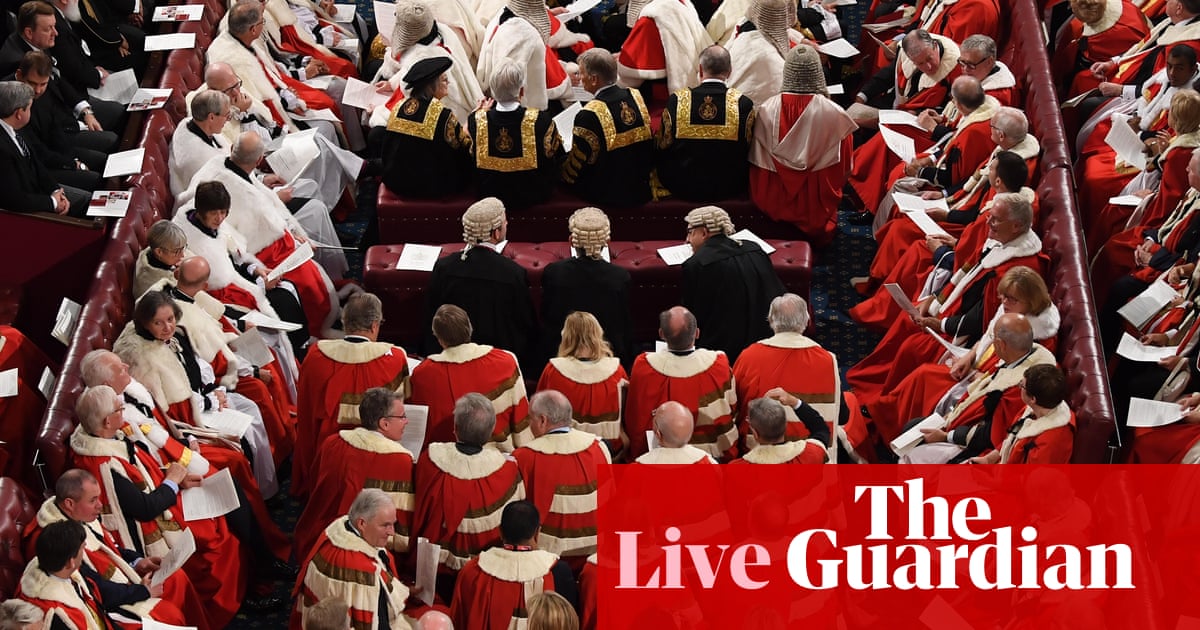
No 10 publishes list of 34 new political peerages – including 25 Labour, 5 Lib Dems and 3 Tories
Downing Street has published a list of political peerages.
There are 25 new Labour peers on the list, five new Lib Dem peers, three new Tory ones.
Three of the peers on the list are hereditary peers who are getting an upgrade to a life peerage, so they can stay in the Lords when the legislation to remove hereditary peers finally gets passed. One of these is a crossbencher, the Earl of Kinnoull.
Key events
-
Early evening summary
-
How Tories will still be largest party in Lords, even with 25 new Labour peers arriving, and hereditaries leaving
-
Who are the 3 new Tory peers?
-
Who are the 5 new Lib Dem peers?
-
Who are the 25 new Labour peers?
-
No 10 publishes list of 34 new political peerages – including 25 Labour, 5 Lib Dems and 3 Tories
-
Tory censure motion demands four different apologies from Rachel Reeves over alleged budget errors.
-
27 Council of Europe countries back statement saying ECHR should allow ‘innovative’, Rwanda-style migration policies
-
UK ‘all in’ in implementing Aukus defence pact, says John Healey after meeting at Pentagon
-
Work on peace plan ‘continuing’ at this ‘critical moment’ for Ukraine, Starmer, Trump, Macron and Merz agree in call
-
ECHR rethink risks ‘dismantling safety net that protects every one of us’, says campaign group Liberty
-
No 10 says Trump was ‘wrong’ when he criticised Sadiq Khan
-
What experts think about UK joining customs union with EU
-
UK joins call for Europe’s human rights laws to be ‘constrained’
-
Starmer says he sees Europe as ‘strong’, but ducks invitation to criticise Trump’s ‘deeply alarming’ Europe-critical security plan
-
Council of Europe agrees to look at how ECHR applied in context of ‘challenges posed by irregular migration’
-
Badenoch claims at PMQs government failing because ministers too focused on trying to replace Starmer
-
Badenoch criticises Farage over refusal to apologise for alleged racist remarks
-
PMQs – snap verdict
-
Starmer rules out joining customs union with EU, saying it would not be sensible to ‘unravel’ trade deal with US
-
Starmer reveals British soldier killed in accident in Ukraine while observing soldiers testing equipment away from frontline
-
Starmer faces Badenoch at PMQs
-
Reeves rejects claim raising income tax would have been more progressive than threshold freeze
-
Reeves rejects claim budget contains unrealistic plans to restrict public spending at end of decade
-
Reeves rules out putting capital gains tax on primary residences, and moving to pensions ‘single lock’
-
Reeves says decision not to raise income tax taken by her and Starmer ‘as a team’
-
Reeves says there were ‘too many leaks’ ahead of budget, but procedures being reviewed, and leak inquiry underway
-
Lammy says Council of Europe ‘heading for politcal declaration’ on ECHR
-
Starmer says £500m boost to youth services will give every child ‘chance to thrive’
-
Nandy says she does not think Australian-style social media ban for teenagers could be enforced in UK
-
Asylum overhaul in UK could lead to rise in homelessness and backlogs, says report
-
Rachel Reeves faces Treasury committee before Tory censure motion in Commons saying she misled voters about budget
Early evening summary
-
Resident doctors are to be consulted on whether or not to call off their upcoming strike after receiving an offer from the government, the British Medical Association (BMA) has said. As PA Media reports, medics are due to walk out for five days from 17 December due to an ongoing row over pay and concerns over training places. The BMA said the government has put forward an offer on “ending the jobs crisis for doctors in England”. It said that resident doctors will be consulted over whether this offer is enough to call off next week’s walkout through an online survey, which will close on Monday 15 December.
For a full list of all the stories covered on the blog today, do scroll through the list of key event headlines near the top of the blog.
How Tories will still be largest party in Lords, even with 25 new Labour peers arriving, and hereditaries leaving
The Conservatives are currently the largest party in the House of Lords. But, with 822 peers currently in the Lords in total, they don’t have a majority. No party ever has, in recent times, because of the large number of crossbenchers.
Even when the new peers announced today take their seats, the Tories will still be the largest party.
Before the end of this parliamentary session, the House of Lords (hereditary peers) bill is due to become law. That will remove the remaining hereditary peers (many of whom are Conservative) from the Lords. But even then the Tories will still be the largest party.
The House of Lords bill has gone through the Commons and the Lords. But it has not been debated since September, when MPs voted out Lords amendments, including one that would have allowed the remaining hereditaries to stay in the Lords until they die. This dispute will have to be resolved in “ping pong” between the two house, and the government whips seems to be saving this up until much closer to the end of this session of parliament.
Here are the figures showing how many peers there are in the Lords by party, what difference the new appointments will make, and what will happen to the numbers when the remaining hereditary peers are removed.
Conservatives
Now: 282
With new peers: 285
Without hereditaries: 241
Labour
Now: 209
With new peers: 234
Without hereditaries: 230
Crossbenchers
Now: 177
With new peers: 177
Without hereditaries: 147
Liberal Democrats
Now: 75
With new peers: 78 (two of the new peerages announced today have gone to people who are already hereditary peers).
Without hereditaries: 76
Others (non-affiliated, bishops and smaller parties)
Now: 79
With new peers: 79
Without hereditaries: 77
Who are the 3 new Tory peers?
And here are the three new Tory peers, as set out on the list from Downing Street.
Sharron Davies MBE – Campaigner for Women’s Rights & Olympic Swimming Silver Medallist for Great Britain
Simon Heffer – Professor of Modern British History at the University of Buckingham and a historian, journalist, author and political commentator
The Rt Hon Sir John Redwood – Former Cabinet Minister and Member of Parliament for Wokingham
Who are the 5 new Lib Dem peers?
Here are the five new Lib Dem peers, as set out on the list from Downing Street.
Mike Dixon – CEO of the Liberal Democrats
Dominic Hubbard (Lord Addington) – Lately Liberal Democrat hereditary Peer, President of the British Dyslexic Association and Vice President, the UK Sports Association
Rhiannon Leaman – Former Chief of Staff to the Leader of the Liberal Democrats
John Russell (Earl Russell) – Lately Liberal Democrat hereditary Peer, photographer
Sarah Teather – Former MP, former minister and Charity CEO
Who are the 25 new Labour peers?
Here are the new Labour peers, as set out on the list from Downing Street.
Andy (Andrew) Roe KSFM – Chair of the national Building Safety Regulator and former London Fire Commissioner
Dame Ann Limb DBE DL – Former Further Education College Principal and former Chair, The Scouts. Pro Chancellor, University of Surrey, and Chair of City & Guilds Foundation, Lloyds Bank Foundation, and The King’s Foundation
Brenda Dacres OBE – Mayor of Lewisham
Carol Linforth OBE – Lately Labour Party Chief of Staff – Operations
Catherine MacLeod – Former journalist and political adviser, Visiting Professor at King’s College London and Non-Executive Director at the Scotland Office
David Isaac CBE – Provost of Worcester College, Oxford, Chair of the University of the Arts London, Chair of the Henry Moore Foundation, and a trustee of Cumberland Lodge
David Pitt-Watson – Responsible Investment Expert. Co-founder and former CEO of the Equity Ownership Service and Focus Funds at Federated Hermes
Farmida Bi CBE – Chair of Norton Rose Fulbright LLP, Vice-Chair of the Disasters Emergency Committee
Professor Geeta Nargund – Founder and former Medical Director of Create Fertility. Founder and Trustee of Health Equality Foundation
Katie Martin – Lately, Chief of Staff to the Chancellor of the Exchequer
Joe Docherty – Chair of Northern Powergrid Foundation and Trustee, Esmee Fairbairn Foundation, former Chair of Council, Durham University
Len (Leonard) Duvall OBE – Chair of the London Assembly and Leader of the London Assembly Labour Group
Matthew Doyle – Former Director of Communications to the Prime Minister and for the Labour Party
Sir Michael Barber – Chancellor, University of Exeter and adviser to the Prime Minister on effective delivery
Neena Gill CBE – Former Member of the European Parliament for the West Midlands
Nick (Nicholas) Forbes CBE – Chair, Breaking Down Barriers Commission and former Labour Leader, Newcastle City Council
Peter Babudu – Executive Director of Impact on Urban Health, former councillor in Southwark
Peter John OBE – Former Southwark Leader and former Chair of London Councils.
Richard Walker OBE – Founder and Chairman, Bywater and Executive Chairman, Iceland Foods
Russell Hobby CBE – CEO, The Kemnal Academies Trust, former CEO, Teach First and former General Secretary of the National Association of Head Teachers
Cllr. Dr Sara Hyde – Fabian Society Chair and Islington council’s Executive Member for Health and Social Care
Cllr. Shama Tatler – Brent Councillor and Vice-Chair of the London Labour Regional Executive, Patron of the Labour Housing Group and Head of the Labour Group Office at the Local Government Association
Dr Sophy Antrobus MBE – Senior Research Fellow and Co-Director of the Freeman Air and Space Institute at King’s College London
Tracey Paul – Chief Communications Officer at Pool Reinsurance and former policy advisor
Uday Nagaraju – Technology Consultant, Politician and Founder of AI Policy Labs
No 10 publishes list of 34 new political peerages – including 25 Labour, 5 Lib Dems and 3 Tories
Downing Street has published a list of political peerages.
There are 25 new Labour peers on the list, five new Lib Dem peers, three new Tory ones.
Three of the peers on the list are hereditary peers who are getting an upgrade to a life peerage, so they can stay in the Lords when the legislation to remove hereditary peers finally gets passed. One of these is a crossbencher, the Earl of Kinnoull.
The debate on the censure motion is about to start.
Caroline Nokes, the deputy speaker, says that, because of the wording of the motion, MPs will be allowed to make comments about the chancellor that would not normally be allowed (accusing her of being misleading – see 8.45am). But she urges MPs to keep their comments respectful anyway.
Mel Stride, the shadow chancellor, is opening the debate.
He says Rachel Reeves has achieved record low approval ratings. Even Jeremy Corbyn and Liz Truss were more popular, he says. He goes on:
The chancellor is not so much a wilting lettuce, as a complete liability.
Tory censure motion demands four different apologies from Rachel Reeves over alleged budget errors.
In the Commons MPs will soon be starting the second opposition day debate – the censure motion against Rachel Reeves. It accuses the chancellor of “misleading the country” and it is demanding four separate apologies from her over alleged, budget-related errors.
Here is the motion.
That this House calls on the chancellor of the exchequer to apologise for misleading the country about the state of the public finances, rolling the pitch for raising taxes, breaking her promises and increasing welfare spending, including her claim on 4 November 2025 that the OBR would be downgrading their productivity forecast which, as the chancellor said, had ‘consequences for the public finances too, in lower tax receipts’, when in fact on 31 October 2025 the OBR had submitted its forecast to the Chancellor that showed tax receipts would be £16bn higher than previously thought, resulting in the government’s current balance target being met by a margin of £4.2bn; further calls on the Chancellor to apologise for breaching the trust of the OBR, whose forecasts are shared in strict confidence until the chancellor has given her budget Statement; also calls on the chancellor to apologise for the misleading briefings and leaks from HM Treasury in advance of the budget statement which caused uncertainty for families, businesses and investors; and calls on the chancellor to apologise for breaking her promise after the last budget that the government was not going to raise taxes again, instead raising taxes in the 2025 budget by £26bn.
27 Council of Europe countries back statement saying ECHR should allow ‘innovative’, Rwanda-style migration policies
As Rajeev Syal reports, 27 of the 46 countries in the Council of Europe have signed a statement saying that interpretation of the European convention on human rights should be “constrained” to make it easier for governments to tackle unauthorised migration.
The full text of that document has been published here.
It is considerably stronger and more specific than the agreement reached by all 46 member countries.
Here is an extract.
States aligned to this statement consider it imperative to ensure that the convention framework is fit to address today’s challenges, most notably in order to meet the following challenges:
• Expulsion of foreigners convicted of serious crimes: The clear starting point is that a state party can expel foreigners convicted of serious crimes even though they have acquired ties to their host Country, eg. if they have established a family life there. In line with the principles in this statement, it is vital that the balance between individual rights and legitimate aims as per article 8 of the convention [the right to a family life] is adjusted so that more weight is put on the nature and seriousness of the offence committed and less weight is put on the foreign criminal’s social, cultural, and family ties with the host country and with the country of destination. The purpose of such a rebalancing is to ensure that we no longer see instances where foreigners convicted of serious crime, including serious violent crime, sexual assault, organised crime and human and drug trafficking, cannot be expelled.
• Clarity about inhuman and degrading treatment: The scope of “inhuman and degrading treatment” under article 3 [the ban on torture, and inhuman or degrading treatment], which is an absolute right, should be constrained to the most serious issues in a manner which does not prevent state parties from taking proportionate decisions on the expulsion of foreign criminals, or in removal or extradition cases, including in cases raising issues concerning healthcare and prison conditions.
• Innovative and durable solutions to address migration: A state party should not be prevented from entering into cooperation with third countries regarding asylum and return procedures, once the human rights of irregular migrants are preserved.
As Rajeev points out, this would explicitly allow programmes like the last government’s Rwanda plan.
The Danish government says Denmark and Italy led the way in gathering support for this statement.
UK ‘all in’ in implementing Aukus defence pact, says John Healey after meeting at Pentagon
The UK is “all in” on overcoming barriers to fully implementing the Aukus security partnership with the United States and Australia, John Healey has said following positive talks in the US. PA Media says:
The Ministry of Defence (MoD) said all three countries had committed to delivering the agreement after the defence secretary met US secretary of war Pete Hegseth and Australian defence minister Richard Marles at the Pentagon.
Aukus was formed in 2021 to deepen cooperation on security and defence, with a focus on helping Australia to acquire nuclear-powered submarines and developing advanced military technologies.
The US recently concluded a review of the Aukus agreement aimed at ensuring “its long-term success” and “alignment with the president’s ‘America First’ agenda”, raising doubts about the future of the partnership.
But today’s meeting “marked a decisive shift towards delivery for submarine development and turning advanced military technology projects into frontline warfighting capabilities under Pillar II”, the MoD said.
Healey added: “This is full steam ahead for Aukus. Our reviews are done. Now, we deliver.
“In this new era of threat, with adversaries who are increasingly cooperating, business as usual is not an option.
“Aukus is too significant and the stakes are too high for it to be allowed to drift. Our driving focus now is overcoming any barriers to delivery. And the UK is all in.
“With billions being invested in UK infrastructure, this programme demonstrates defence as an engine for growth – boosting our shared security, keeping our people safe and creating good jobs across our three nations.”
Work on peace plan ‘continuing’ at this ‘critical moment’ for Ukraine, Starmer, Trump, Macron and Merz agree in call
Keir Starmer has spoken to Donald Trump in a joint call about Ukraine with Emmanuel Macron, the French president, and Friedrich Merz, the German chancellor, Downing Street has said.
But that is about all that it has said about the conversation. Here is the full readout.
The prime minister spoke to the president of the United States, Donald Trump, the president of France, Emmanuel Macron, and the chancellor of Germany, Friedrich Merz today.
The leaders discussed the latest on the ongoing US-led peace talks, welcoming their efforts to achieve a just and lasting peace for Ukraine, and to see an end to the killing.
Intensive work on the peace plan is continuing and will continue in the coming days.
They agreed that this was a critical moment – for Ukraine, its people and for shared security across the Euro-Atlantic region.
Kemi Badenoch’s approval ratings have reached a new high for 2025, according to new polling from More in Common. But she is still behind Nigel Farage and Ed Davey. This is from More in Common’s UK director, Luke Tryl.
Starmer’s net approval is at -48. Badenoch’ approval reaches another new high for the year at -14. With Davey and Farage down slightly at -11 and -12 respectively it’s now a virtual three way tie for most approved (or least disapproved of).
ECHR rethink risks ‘dismantling safety net that protects every one of us’, says campaign group Liberty
Liberty, the campaign group, has said that Britain and other countries pushing for a review of the way the European convention on human rights is implemented are putting rights at risk. Referring to today’s agreement (see 1.57pm), it has issued this statement from its director, Akiko Hart.
With today’s announcement in Strasbourg, the government risks taking us down a road of no return by jeopardising the legal framework that protects us all.
Undermining the European convention on human rights risks dismantling a safety net that protects every one of us. These discussions must be rooted in facts and evidence, not exaggerated narratives and the demonisation of our communities.
For over 70 years, these laws have quietly underpinned our daily lives: giving us the ability to speak freely, love who we want and ensuring we can hold those in power to account.
The government are defending reforms to the ECHR in the name of public interest, yet they must be honest about what people stand to lose if they lay the groundwork for further diminishing our human rights. The ECHR is a vital foundation of our freedoms, and it is essential that any changes do not open the door to the slow erosion of our rights, now or in the future.
No 10 says Trump was ‘wrong’ when he criticised Sadiq Khan
Donald Trump described Sadiq Khan, the Labour mayor of London, as a “horrible, vicious, disgusting mayor” in an interview published yesterday.
At the No 10 post-PMQs briefing today, the PM’s press secretary said that Trump was “wrong” about the mayor. She said:
Those comments are wrong.
The mayor of London is doing an excellent job in London, delivering free school meals in primary schools, cleaning up London’s air with the world’s largest clean air zone and starting record numbers of council houses.
The prime minister is hugely proud of the mayor of London’s record and proud to call him a colleague and a friend.
Asked what aspects of the Trump comments were wrong, the press secretary declined to elaborate.
In his interview (transcript here), Trump also said:
[Khan is] a disaster. He’s a disaster. He’s got a totally different ideology of what he’s supposed to have. And he gets elected because so many people have come in. They vote for him now because you know, it’s like … it’s uh, one of those things. But I hate what’s happened to London, and I hate what’s happened to Paris. I hate when I see it.
What experts think about UK joining customs union with EU
I have beefed up the post at 12.21pm with the full quotes from Keir Starmer replying to Ed Davey about the customs union, and why Starmer thinks joining a customs union with the EU would be a mistake because “it is not now sensible to unravel what is effectively the best deal with the US that any country has got”. You may need to refresh the page to get the update to appear.
On Brexit Bluesky, there is some scepticism as to whether joining a customs union with the EU that some of its supporters suggest. These are from Prof Anand Menon, who runs the UK in a Changing Europe thinktank.
On the whole customs union debate, worth bearing a few things in mind. The ‘research’ on which the claims of economic benefit are based isn’t about a CU but about the EU accepting ‘deep alignment on goods and services’ – which it won’t. 1/3
So the numbers are just plain wrong. On top of which, does anyone know if the EU will negotiate a CU of any kind with us, and what they might ask in return? They wanted 6 billion to let us into SAFE, remember 2/3
And let’s please stop with the idea that a CU of any kind will end the need for paperwork etc. The real costs of Brexit come from being outside the single market. Apart from that, it’s a fab idea, so well done lads. 3/3
I’ve so missed these discussions about UK-EU relations that are solely about us, and political positioning here, rather than about the, you know, UK-EU relationship 4/3
These are from Aslak Berg from the Centre for European Reform thinktank.
Is there a trade expert out there arguing for a UK-EU customs union? I think it’s fair to say that @davidheniguk.bsky.social @samuelmarclowe.bsky.social and myself are hardly Euroskeptics, and while we emphasise different things in talking about a CU the conclusion is unanimous
Sam: technically it wouldn’t work because of X, Y, Z
David: the EU doesn’t really want it and would in any case extract a price
Me: it wouldn’t work politically for the UK
Different emphases, same conclusion
And this is from David Henig, director of the UK Trade Policy Project at the European Centre for International Political Economy thinktank.
All fine and technical, but the key point is that there is nothing called “Customs Union” that is simply off the shelf instantly available next-day Amazon delivery, everything will need negotiation with the EU, and their top asks of the UK will be mobility and money.
UK joins call for Europe’s human rights laws to be ‘constrained’
Rajeev Syal has more on what happened at the Council of Europe meeting today. He reports:
The UK has joined some of Europe’s hardline governments in calling for human rights laws to be “constrained” to allow Rwanda-style migration deals with third countries and more foreign criminals to be deported.
Twenty-seven of the 46 Council of Europe members including the UK, Hungary and Italy have signed an unofficial statement that also urges a new framework for the European convention of human rights, which will also narrow the definition of “inhuman and degrading treatment”.
And here is the full story.
Starmer says he sees Europe as ‘strong’, but ducks invitation to criticise Trump’s ‘deeply alarming’ Europe-critical security plan
Here are the direct quotes from when Ed Davey, the Lib Dem leader, asked Keir Starmer at PMQs to criticise the new US national security strategy. (See 12.21pm.) Starmer described Europe as “strong”, after Donald Trump yesterday said it was “weak”. But he did not directly condemn the strategy document.
Davey said:
President Trump’s new national security strategy is a deeply alarming document.
Quite apart from the irony of President Trump accusing others of trampling on basic principles of democracy, it repeats far-right tropes of civilisational erasure and threatens that the US government will cultivate resistance in Europe. No wonder Vladimir Putin has welcomed that strategy.
So, will the prime minister pick up the phone and make it clear to President Trump that any attempts to interfere with our democracy are totally unacceptable?
And Starmer replied:
What I see is a strong Europe, united behind Ukraine and united behind our longstanding values of freedom and democracy, and I will always stand up for those values and those freedoms.
In response, Davey said he “didn’t hear about standing up to President Trump”.
This is what my colleague Rafael Behr said about the No 10 response to the US document on Bluesky earlier.
I can’t help thinking that when, in future, people ask what UK political leaders said as it became undeniable that US saw European liberal democracy as its no1 strategic foe, Starmer and others will regret that the answer is “not much, shuffled awkwardly, looked at their feet”.
Go on. It’s the biggest geopolitical pivot of the past 100+ years. It’s an existential moment of crisis for a set of political values that we hold to be the foundation of decent society. Would it kill you to show that you have noticed; to say, I dunno, *something*?