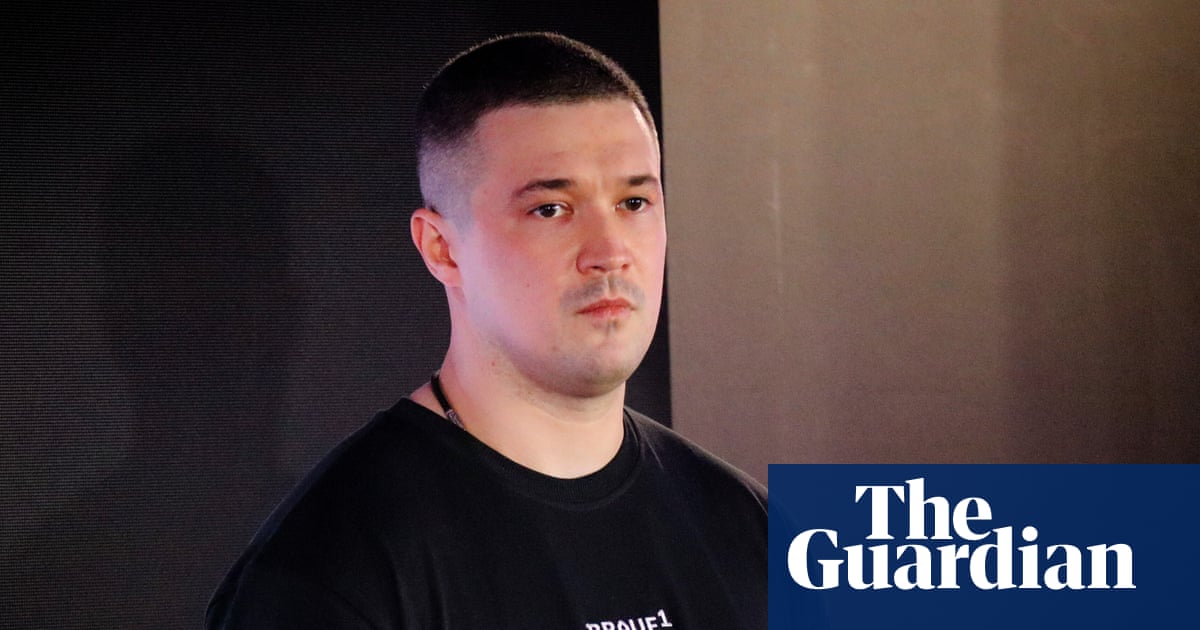
The abrupt dismissal of Ukraine’s youthful and innovative defence minister, Mykhailo Fedorov, by Volodomyr Zelenskyy at precisely the moment Kyiv appeared to be gaining advantages in several spheres of its war with Russia has exposed, not for the first time, a troubling flaw in the president’s leadership.
The move, which has startled senior European officials and caused consternation in Ukraine – where it has prompted demonstrations – is all the more shocking given Fedorov’s role in pushing a clear strategy to prosecute the war, leveraging Ukraine’s rapidly developing technological advances in drone and missile technology.
Aged just 35 and appointed in January, Fedorov was feted by admirers for beginning to grasp multiple issues that have plagued Ukraine’s armed forces, streamlining military procurement and challenging systems prone to corruption, introducing competitive tendering, and seeking solutions to the army’s persistent manpower and training crisis.
Fedorov was also seen as one of the key drivers of Ukraine’s highly effective drone programme, beginning during his time as minister of digital transformation.
A former marketing executive close to Zelenskyy, who had never served in the army, he grated with senior officers thanks to his casual style, freewheeling speeches and insistence on a data-driven approach to reforming Kyiv’s war efforts.
“We will take all the data and see what works,” he said after his appointment. “Everything that works well will proceed.” That included a killing-for-points scheme designed to reward the most effective army units, which some in the military dismissed.
In addition, Fedorov was credited with persuading Elon Musk to turn off unauthorised Russian Starlink access on the battlefield earlier this year, described by frontline troops as a significant advantage.
Born in the year of Ukraine’s independence from Moscow, Fedorov is seen as part of a generation unencumbered by the experience of Soviet bureaucracy, in sharp contrast to his arch-rival, the country’s 60-year-old military chief of staff Oleksandr Syrski, a graduate of Moscow higher combined arms command school, who began his career as an artillery officer.
With hindsight, the conflict between the two men and their ideas about how to fight the war was inevitable: between an older – and old-school – general, micromanaging a bruising war of attrition against a more numerous foe, and Fedorov, with his tech-driven and more improvisational approach that appeared in recent months to be showing dividends.
While bitter competition between key wartime leaders is hardly new, the failure, not least in the opinion of Fedorov and his supporters, has been in Zelenskyy’s handling of the rivalry, which had seen Fedorov request the removal of Syrski.
“When the president said he did not plan to replace Syrskyi, I said I would learn to work with him,” Fedorov said at the press conference after his removal, suggesting the general sought to block the defence minister’s initiatives at every turn.
“All the initiatives we proposed began to be blocked,” he added. “And he was not prepared to discuss any of the problems we have spoken about today personally, face to face and openly.
“Instead of finding a way of defeating Russia asymmetrically – which is the commander-in-chief’s job – he’s found a way of splitting our country,” Fedorov said bitterly.
While it is clear a toxic dynamic had emerged at the very top of Ukraine’s wartime leadership, Zelenskyy’s own parsing of the situation, at a joint press conference on Thursday with outgoing UK prime minister Keir Starmer, was unconvincing as he appeared to complain that he was being asked “to choose between sides [when honestly] what I want most is unity”.
All of which has led to inevitable suggestions that Zelenskyy and his circle – not for the first time – had sidelined someone seen as popular and a potential future political rival.
after newsletter promotion
“The decision,” said a leader in the Kyiv Independent, “bears all the hallmarks of Zelenskyy’s tendency to dismiss top officials and commanders who get too popular, ahead of hypothetical elections that will never happen if Russia overwhelms Ukraine.
“Forced to choose between the man who was turning the war of attrition around with technology and intelligent strategy on one hand, and the man who was sabotaging it with micromanagement and Soviet thinking on the other, Zelenskyy thought about it and chose the latter.”
And as demonstrations continued for a second day over Fedorov’s removal, the question now is what lasting impact it will have as a fifth defence minister is appointed in as many years.
For Zelenskyy it underlines again the fact that, impressive as he is on a global stage and as a wartime figurehead for Ukraine, he has struggled to assemble and retain a cohesive team of senior officials around him, balancing competing interests to ensure continuity in the war effort.
While Russian military bloggers have celebrated the ousting of Fedorov, Zelenskyy’s move to appoint Yevhen Khmara as interim defence minister suggests that, despite the feud between Fedorov and Syrski, the emphasis on technology and long- and medium-range drone strikes is likely to persist. Khmara is a former head of the state security service’s Alpha unit, which has been heavily involved in drone strike operations.
Zelenskyy has indicated he also wants Khmara to push forward with a number of Fedorov’s key reform programmes.
The question, however, that many Ukrainians find themselves asking is whether anyone genuinely can be empowered to be effective in the role.