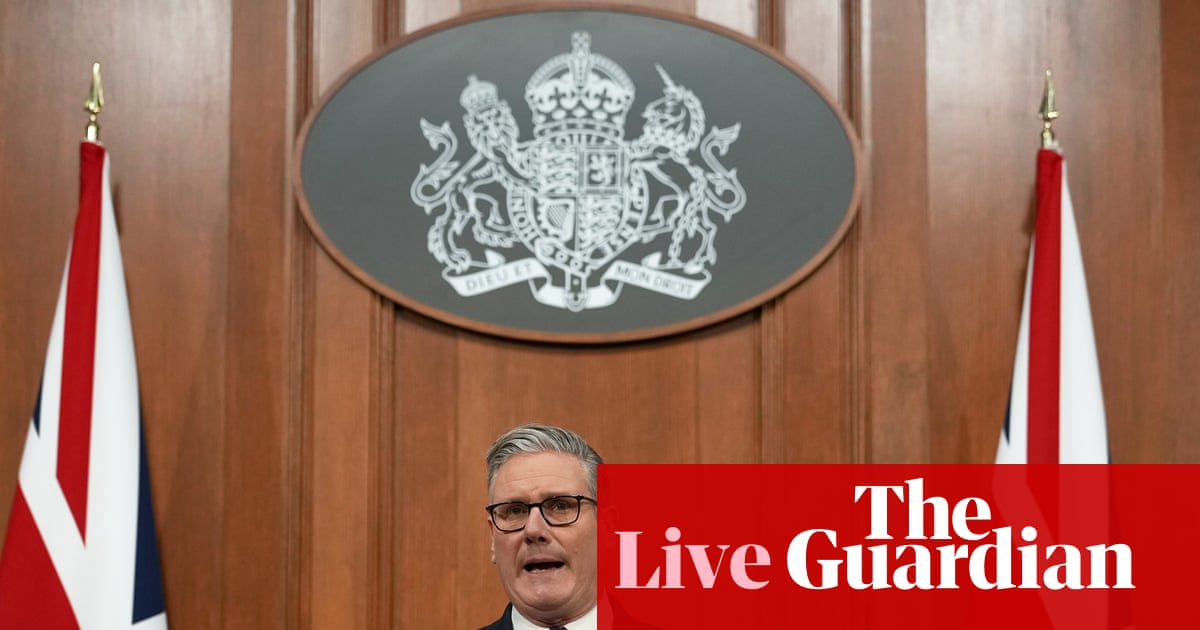
Starmer says, with global volatility, UK’s long-term national interest requires ‘closer partnership’ with EU
Starmer rattles through a list of other measures taken by the government to help with the cost of living.
But he says, in the future, “it is not going to be easy”.
He goes on:
We will continue to stand up for the British national interest, and we continue to do what we must to guide our country calmly through this storm.
However, it is increasingly clear that as the world continues down this volatile path, our long-term national interest requires closer partnership with our allies in Europe and with the European Union.
Key events
Greens claim ‘quickest way to open strait of Hormuz is to tell US and Israel to end war’
The Green party says Keir Starmer should be more explicit about telling the US and Israel that they must end the war against Iran. It released a statement from the Green MP Siân Berry saying:
Keir Starmer is at last waking up to the need to look to partners across the European Union rather than the US for long-term security. However, he is still refusing to oppose the US war in Iran that is destabilising the whole region.
Parliament has never agreed to UK bases being used to facilitate the US war on Iran, nor has it agreed to a further build up of UK troops just as thousands of US marines and paratroopers arrive for a possible ground invasion. Now Keir Starmer is offering to take the international lead on clearing up Trump’s regional destabilisation by hosting a summit on how to reopen the strait of Hormuz.
Keir Starmer claims the growing involvement is just defending UK and allies’ interests, but won’t put that to parliament for a vote. He knows the quickest way to open the strait of Hormuz is to tell the US and Israel to end their war.
Here is the full text of Keir Starmer’s opening statement at his press conference.
Iran likely to end up charging for ships to go through strait of Hormuz, former Foreign Office chief says
Peter Ricketts, the former head of the Foreign Office and former national security adviser, has told Radio 4’s the World at One that he thinks countries like the UK may end up having to pay tolls to Iran, after the war is over, to get their supplies through the strait of Hormuz.
Asked to comment on the PM’s plan for a multinational initiative to reopen the strait (see 10.18am), Ricketts said:
The reality is that no western nation is going to put naval vessels through the strait of Hormuz against the declared opposition of the Iranians. It would simply be too dangerous to do that …
I think we have to face the fact that Iran has learned they can monetise passage through the straits and they’re not going to give that up.
So I don’t think we’re going to go back to free passage through the strait of Hormuz as if nothing had happened. I think they are going to, durably, be charging nations, shipowners, for their vessels to go through the strait, partly to raise money for the enormous reconstruction that they’re going to have to do.
So that’s where I think the durable shock comes from. Energy is going to be more expensive, and I don’t think there’s any western military escorting operation that is going to clear that.
Ricketts said he thought nations would be willing to pay Iran for this because that would be a better option than having the strait closed. And he said he could imagine European countries negotiating with Iran for access on this basis.
But there was likely to be a cost, he said.
It’s all very unattractive and uncomfortable, but I don’t think the Iranians are simply going to stand back and say, ‘Right, strait now open, you can sail through whatever you like.’
Labour dismisses Badenoch’s proposed ‘national pothole patrol’ as ‘gimmick’
If you vote Conservative in the English local elections, Kemi Badenoch will come out personally and fix the pothole at the end of your road.
That, of course, is not true. But it is the impression given by the photocall she has taken part in this morning. She was promoting Tory plans for what they call a “national pothole patrol”.
This is what the party says about how it would work.
Under the plan, a new national pothole patrol will be backed by £112.5m to deploy hundreds of modern, specialist road-repair machines directly to councils, fixing potholes faster, at scale, and where they are worst. This will cost £225m in total with our golden economic rule where at least half of every pound we save will go towards cutting the deficit. This is funded by savings made from the government’s communications contracts with external consultants.
It comes as Britain’s roads reach breaking point under Labour. 12.8 million drivers suffered pothole damage last year, while the repair backlog has hit a record £18.6bn.
The Conservatives will also introduce a single national reporting platform, replacing the current mess of local websites so drivers can report potholes quickly and repairs can be targeted where they are needed most.
This will end the current patchwork approach and deliver a coordinated national effort to repair Britain’s roads properly.
Badenoch was wearing a personalised jacket with the slogan ‘Kemi’s pothole patrol’ on the back. Earlier this week she was wearing another personalised jacked in Scotland. Badenoch’s approval ratings are higher than her party’s, and the Tory campaign seems to be prioritising her ‘brand’.
Responding to the Tory announcement, a Labour spokesperson said:
The Tories spent 14 years failing to fix our roads, leaving drivers to deal with a pothole crisis on their watch. Now they’re offering gimmicks instead of taking responsibility for the mess they created.
After years of Tory neglect, this Labour government is delivering the biggest-ever investment in road maintenance, with a record £7.3bn boost to local roads – enough to fill millions of potholes every year – alongside a new traffic light rating system to hold councils to account.
And this is was Liz Saville Roberts, the Plaid Cymru leader at Westminster, has said about Keir Starmer’s press conference.
Today’s update from Keir Starmer will offer little comfort to families and businesses across Wales who are already paying the price of rising energy costs. For many, this crisis is not on the horizon. It is already here.
People who are not protected by the price cap because they are off-grid are being hit first and hardest, with government support leaving the vast majority without help. Many more now face an anxious wait ahead of a likely rise in the price cap in July.
This crisis is driven by global instability, including the conflict in Iran, but its impact is falling unevenly. In Wales, higher standing charges and poorer energy efficiency mean people are paying more as a baseline. Combined with the fact that many households rely on heating oil and LPG, a one size fits all approach simply does not work when costs are so different.
Plaid is calling for a four-nations summit to agree a policy on energy support.
Here is a statement from Mel Stride, the shadow chancellor, that the Conseratives have put out in response to the Keir Starmer press conference.
Keir Starmer’s Labour blame everyone but themselves.
Britain is weaker because of Rachel Reeves and Ed Miliband’s choices. Tax hikes and Labour’s net zero obsession are driving up costs and hitting families in the pocket.
Reeves offers nothing but more borrowing, more taxes, more welfare – and working people are paying for Labour’s spending spree. Hardworking families are almost £1,000 worse off this year, while those on benefits get ever more cash.
Only the Conservatives will Get Britain Drilling in the North Sea, axe the fuel tax hike, cut bills by £200, lower taxes, and deliver a stronger economy and a stronger country.
This is routine political boilerplate which, of itself, is of no real interest at all.
But what is interesting is that the Tories have cobbled together four paragraphs without once addressing the key point of the press conference – Starmer’s suggestion that the UK must align more closely with the EU.
In the past the Tories would vocally condemn any attempt to unwind Brexit. And, while Starmer argued the UK did not have to choose between the US and Europe, the Tories were happy to make a choice – Washington.
Stride’s statement today suggests that they are less confident in both of those positions. They are also mindful, of course, of public support for closer relations with the EU.
Reform UK and Nigel Farage have also not, as yet, responded to what Starmer said about Europe on their social media feeds. Farage says relatively little about Brexit these days, for reasons that are fairly obvious.
(The Mail, though, has not given up fighting for Brexit. The MailOnline story about the press conference is headlined: “PM declares war on Brexit.”)
Scottish Greens call for king to lose tax breaks
The Scottish Greens are calling for the king to lose the tax breaks he gets in Scotland. They are opposed to the monarchy as an institution, but they are saying that if they were in power in Holyrood they would end the exemption that allows the king to buy property in Scotland without paying the land and buildings transaction tax.
Most taxes were the monarchy enjoys an exemption are controlled by the UK government, but this is one that is devolved to Holyrood.
In a statement, Ross Greer, the Scottish Green co-leader, said:
With costs soaring and people being priced out of everyday essentials, it is ridiculous that so much public money is given to one super-rich and scandal-ridden family based on who their ancestors were.
The king is one of the richest men in the world and one of the biggest landowners in Scotland. He doesn’t need even more perks, and he shouldn’t be given a free pass from paying taxes simply because of the wealthy family he was born into.
Swinney declines to back calls for SNP candidate to quit over complaints about how she handled council sexual assault case
The SNP’s selected candidates “will go forward for election”, first minister John Swinney has said, amid calls for a Central Scotland list candidate to resign, the Press Association reports. PA says:
Tracy Carragher, leader of the SNP group on North Lanarkshire Council, is being urged to step down over her handling of sexual assault allegations against former council leader Jordan Linden.
Linden was convicted of 10 separate offences following a trial at Falkirk sheriff court. The convictions included five sexual assaults.
Carragher, who is a list candidate for Central Scotland at the May election, is facing calls to resign after audio clips from a 2022 meeting were made public in which she voiced support for Linden after reports of his crimes.
Swinney has announced an independent review of the SNP’s complaints process.
Speaking to PA. Swinney said: “It’s really important that in all of these situations, we listen to the voices of those who complain and that we address those issues, and that’s exactly the approach that the SNP is taking.
“The review that I have set out will explore and examine all the ways in which these issues have been handled and those issues will be resolved by the SNP.”
When asked by PA if he had confidence in Carragher, Swinney responded: “The party selected its candidates and its candidates will go forward for election.”
On US v Europe, has Starmer finally made his choice? Snap verdict on his press conference
Keir Starmer made two announcements at his press conference this morning. With both, it is hard to tell how significant they will turn out to be – although “questionable” and “potentially, very” might serve as a useful, initial guess.
The PM started by announcing that Britain is convening a meeting of up to 35 nations that are willing to play a role in keeping the strait of Hormuz open. (See 10.18am.) This sounds like an important initiative, and the fact that the meeting is going ahead does show that the UK still exercises some diplomatic clout. But it is very hard to see what this might mean in practice. These 35 countries are not joining the war to support the US. Starmer is talking about some sort of operation to get the strait open after the main conflict has finished, which might be necessary because Trump has suggested he could halt the war with the strait still closed. But if the Iranians are still determined to attack shipping in the strait, the UK and other countries are not likely to dispatch navy ships that might end up as targets, or to launch their own bombing raids against Iranian missile sites. And if the Iranians have lifted the threat to attack shipping, what is there left to do? Mine clearing, perhaps – with Iranian consent? The government may give more details soon, but at the moment it is hard to see how this could make a big difference.
More significant, potentially, was what Starmer said about Europe. As the Sun’s Jack Elsom pointed out, Starmer has always insisted that the choice between the US and Europe is a false one, and that it is in Britain’s best interests to hug them both. (See 11.03am.) But today it sounded like Starmer was choosing; he did not explicitly say that the Trump presidency made the US an unreliable ally, but it obviously has, Starmer knows this as well as anyone, and today he clearly implied that he will respond accordingly. (See 10.24am.)
He also implied that he wants more alignment with EU standards (see 10.57am), in what might be seen a single market membership-lite (assuming the EU allow it – which is by no means certain given their concerns about cherrypicking).
This was not a Harold Macmillan-style ‘Europe is our destiny’ speech. If Brexit does get reversed, it won’t happen in a big, handbrake turn, but in small, incremental shifts. But this is a shift; Elsom was right; although Starmer denied it, he did sound like someone who has made a choice – Europe, not the US.
Quite where this will go, who knows? It is not just a matter of what Trump does, and what Starmer thinks. How the Uk’s relationship with the EU will evolve will depend on domestic politics too, and it may turn out that Brussels offers very little in terms of closer alignment. But, potentially, this could turn out to be meaningful day for post-Brexit policy.
Starmer describes Trump’s Nato threats as ‘noise’, and says they won’t stop him acting in national interest
Q: How seriously do you take President Trump’s threat to withdraw from Nato?
Starmer repeated the suggestion that this was Trump using a threat as a negotiating tactic. (See 10.32am.) He said:
There’s been a good deal of pressure on me to change my position in relation to joining the war. And I’m not going to change my position on the war.
So, whatever the pressure, whatever the noise, I’m the British prime minister, and I have to act in our national interests.
I should say that on defence and security and intelligence, we’re obviously working closely with the US, as we always do.
And in relation to the planning on the strait of Hormuz, of course, that involves talking to the Americans, as well.
That was the last question at the press conference.